The Ultimate PMI-RMP Guide: Master Risk Management Professional Certification in 2026
1. Introduction: The Strategic Value of Risk Management
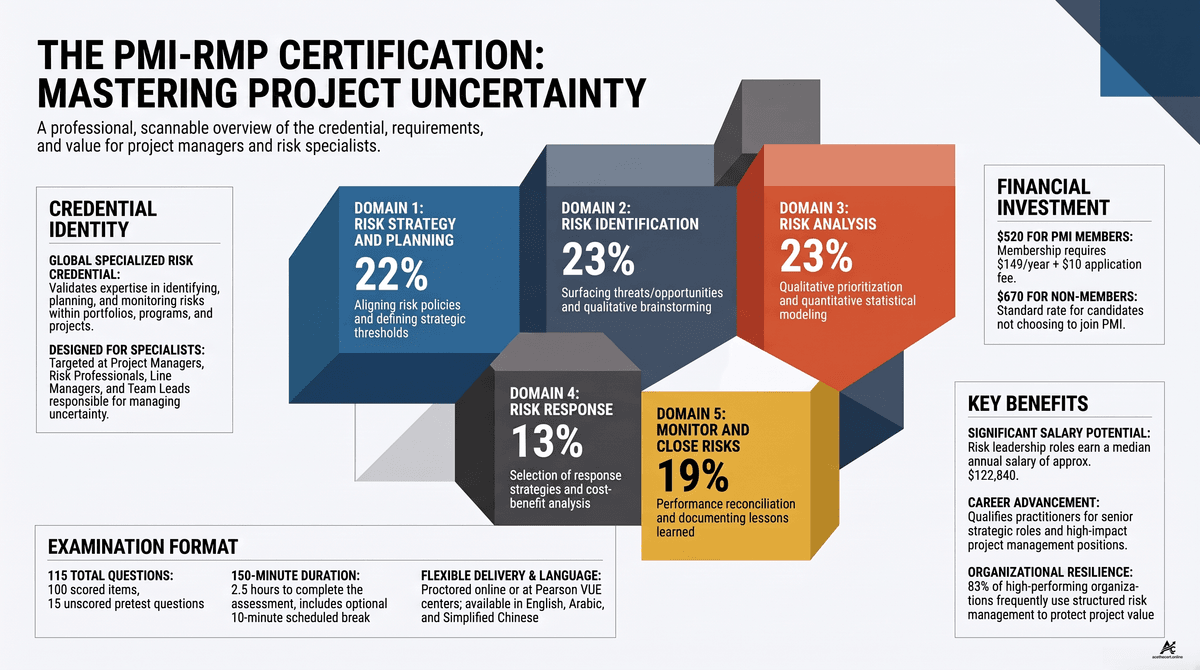
In the volatile business landscape of 2026, organizations face unprecedented uncertainty. The PMI Risk Management Professional (PMI-RMP) certification validates your ability to proactively identify, analyze, and mitigate risks that threaten project success. As a certified RMP, you position yourself as an indispensable specialist who protects organizational investments.
Ready to test your risk expertise? Explore our domain quizzes: Domain 1: Risk Strategy and Planning | Domain 2: Risk Identification | Domain 3: Risk Analysis | Domain 4: Risk Response | Domain 5: Monitor and Close Risks.
2. The Role of a Risk Management Professional
As a PMI-RMP, your role goes beyond maintaining a risk register. You are responsible for:
- Designing and implementing the organization’s risk management strategy.
- Facilitating risk identification workshops with stakeholders.
- Performing qualitative and quantitative risk analysis.
- Developing risk response strategies (avoid, transfer, mitigate, accept).
- Monitoring residual and secondary risks throughout the project lifecycle.
3. Eligibility Requirements
- 4-Year Degree Path: 24 months of unique project risk management experience in the last 5 years + 30 hours of risk management education.
- Secondary Degree Path: 36 months of risk management experience + 30 hours of education.
4. The Five Risk Management Domains
| Domain | Weight | Key Activities |
|---|---|---|
| Risk Strategy and Planning | 22% | Developing the Risk Management Plan, establishing risk thresholds and tolerances, defining risk categories. Quiz → |
| Risk Identification | 23% | Facilitating workshops, using identification techniques (brainstorming, Delphi, SWOT), creating the risk register. Quiz → |
| Risk Analysis | 23% | Qualitative (probability/impact matrix) and quantitative analysis (Monte Carlo, EMV, decision trees). Quiz → |
| Risk Response | 13% | Selecting and implementing response strategies: avoid, transfer, mitigate, accept, escalate. Quiz → |
| Monitor and Close Risks | 19% | Tracking identified risks, monitoring residual risks, identifying new risks, closing risks. Quiz → |
5. Exam Structure
- 115 questions (100 scored, 15 pretest)
- 2.5 hours duration
- Psychometric scoring: Above Target, Target, Below Target, Needs Improvement
- Heavy emphasis on situational judgment and quantitative techniques
6. Key Quantitative Concepts to Master
The PMI-RMP exam tests several quantitative risk techniques:
- Expected Monetary Value (EMV): Probability × Impact
- Monte Carlo Simulation: Probability distribution of outcomes
- Decision Tree Analysis: Expected value of decision alternatives
- Sensitivity Analysis (Tornado Diagrams): Which variables most affect outcomes
- PERT Estimates: (O + 4M + P) ÷ 6
7. Study Resources and Timeline
Plan for 8–12 weeks of focused preparation:
- PMI Practice Standard for Project Risk Management: The core reference.
- PMBOK® Guide 8th Edition: Risk management sections.
- PMI-RMP Exam Prep Books: Specialized practice questions.
- Risk Management Software Tools: Familiarity with Monte Carlo simulation tools.
8. Career Impact
PMI-RMP holders are in high demand in industries with significant regulatory and compliance requirements: Construction, Energy, Finance, Healthcare, IT, and Government. The certification typically commands a 10–20% salary premium over general project managers.
9. Renewal and Maintenance
PMI-RMP renewal requires 30 PDUs every 3 years, distributed across the PMI Talent Triangle:
- Ways of Working: Minimum 8 PDUs.
- Power Skills: Minimum 8 PDUs.
- Business Acumen: Minimum 8 PDUs.
10. Your Path to PMI-RMP Certification
- Verify Eligibility: Ensure your risk management experience meets the requirements.
- Complete 30 Hours of Education: Enroll in a specialized risk management course.
- Study the Five Domains: Focus on Risk Identification and Analysis (combined 46%).
- Practice Quantitative Techniques: Master EMV, Monte Carlo, and decision trees.
- Take Mock Exams: Target consistent 75%+ on practice tests.
- Pass the Exam: Join the ranks of certified risk management professionals.
Frequently Asked Questions
What is the PMI-RMP certification?
What are the PMI-RMP eligibility requirements?
What are the 5 PMI-RMP domains?
How many questions are on the PMI-RMP exam?
How do I renew my PMI-RMP?
Ace The Cert Team
The official editorial team for Ace The Cert.
Related Posts
The Ultimate 2026 CAPM Certification Guide: Your Gateway to Project Management
Pass the CAPM exam on your first try. Learn eligibility, costs, the 4 domains, study roadmap, and career paths for aspiring project managers in 2026.
The Complete PfMP Guide: Master Portfolio Management Professional Certification in 2026
Earn the PfMP and master portfolio management. Learn eligibility, 5 domains, panel review process, and proven strategies to pass the PfMP exam on your first try.
The Complete PMI-PMOCP Guide: Master PMO Professional Certification in 2026
Lead strategic PMOs. Master the PMI-PMOCP with our guide to eligibility, 6 domains, PMO Value Ring, exam structure, and proven prep strategies for 2026.
Comments are not configured for this site.