Mastering the Shift: ITIL 5 Managing Professional Certification Guide
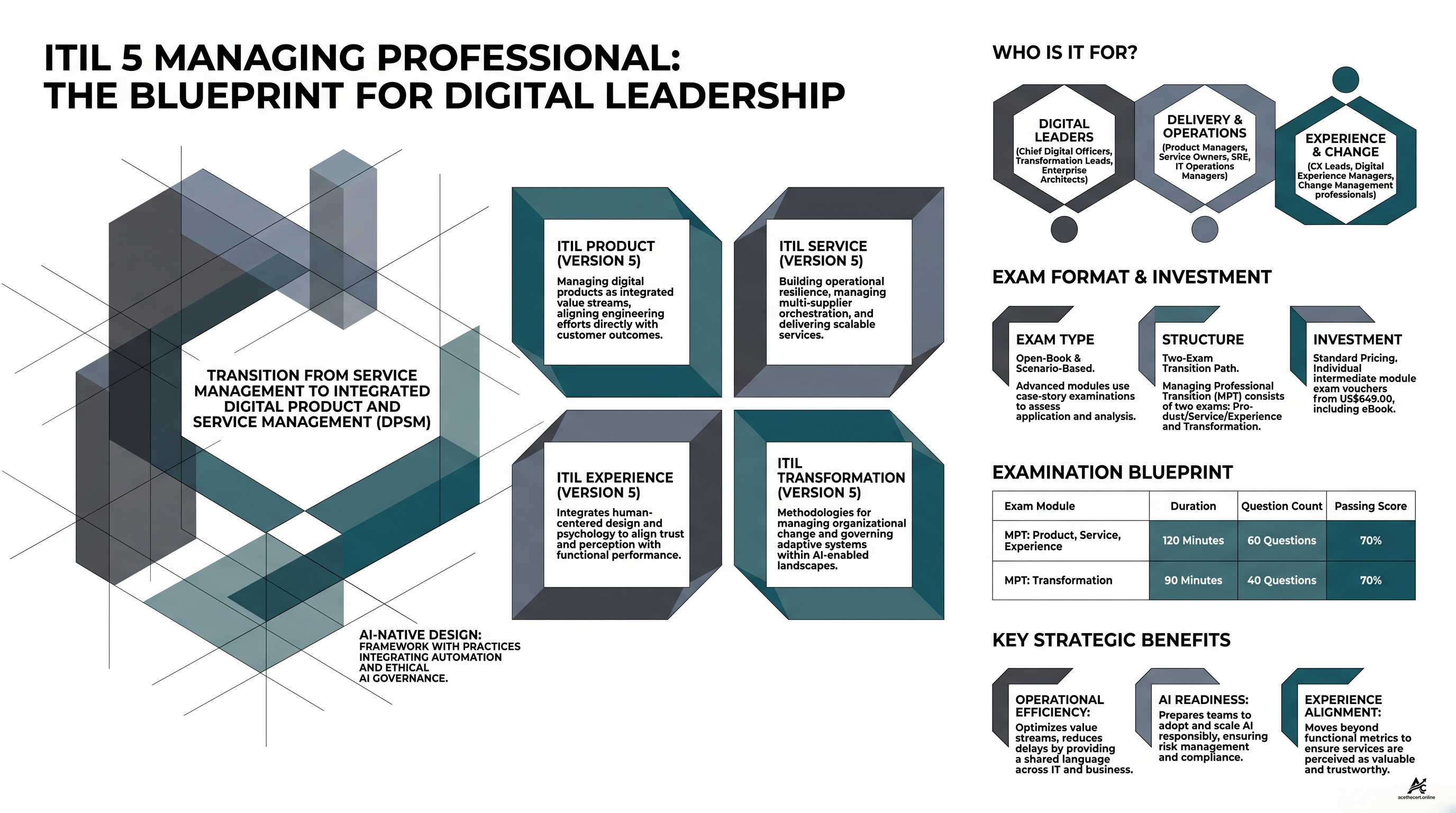
The landscape of technology management has reached a definitive inflection point. Organizations are no longer merely managing “IT services”; they are orchestrating complex digital ecosystems in an AI-enabled, value-driven economy. The shift to Digital Product and Service Management (DPSM) within the ITIL (Version 5) framework represents a fundamental evolution in how we define success. Practitioners must recognize that in this modern operating environment, functional success—meeting technical specifications or uptime targets—is insufficient. True value is co-created at the intersection of performance and stakeholder experience, where services must feel as good as they function to foster trust and long-term loyalty.
The ITIL (Version 5) Managing Professional certification is the strategic benchmark for leaders navigating this transition. This designation validates a professional’s mastery over the full product and service lifecycle, moving seamlessly from discovery and design to build, delivery, and support. By synthesizing technical rigor with human-centric design, the certification ensures that digital products are not only reliable but are strategically aligned with the emotional and cognitive responses of the consumers they serve.
The Version 5 Framework: Strategic Pillars
To master this designation, practitioners must internalize the core enhancements of the Version 5 framework:
- The ITIL Product and Service Lifecycle Model: A dynamic, end-to-end management model covering discovery, design, acquisition, building, transition, operation, delivery, and support. Explore this in our ITIL Product domain guide.
- The ITIL Value System (ITIL VS): An evolved structure that adapts governance and management practices to support digital value chains. See our ITIL Service study guide.
- Notice – Interpret – Hypothesize – Experiment: A sophisticated set of improvement modes designed to drive agility and continual experience improvement.
- Integrated AI Governance: A specialized approach to managing the ethical, transparent, and accountable adoption of artificial intelligence.
This robust framework provides a clear progression path for a diverse range of candidates, offering specific entry points based on professional background and prior certification history.
2. Eligibility and Access: Who Should Pursue ITIL (Version 5) Managing Professional?
Professional readiness for the ITIL (Version 5) Managing Professional designation is predicated on a candidate’s existing journey within the ITIL ecosystem. As a strategic advisor, I encourage professionals to view this not merely as a requirement, but as an opportunity to protect their previous investments while aligning with the most current digital thinking.
The following table outlines the designated pathways to this credential:
| Transition Path | Greenfield Path |
|---|---|
| Eligibility: Current ITIL 4 Managing Professionals, ITIL v3 Experts, and ITIL 4 or v3 Masters. | Eligibility: Newcomers or practitioners holding ITIL 4 Foundation* or ITIL (Version 5) Foundation. |
| Focus: An efficient “changes-only” route that bridges existing expertise to Version 5 capabilities without redundancy. | Focus: A comprehensive journey through the full ITIL (Version 5) lifecycle and all advanced modules. |
| *Note: ITIL 4 Foundation certificates are valid prerequisites; however, certifications in Cloud and Sustainability are excluded from the Foundation Bridge eligibility. |
Practitioners must understand that the Managing Professional Transition (MPT) route is a high-velocity bridge. It focuses exclusively on the modifications and enhancements inherent to Version 5, such as the nuances of DPSM and updated operating models. This ensures that seasoned experts can move forward with momentum, bypassing the reassessment of unchanged ITIL 4 concepts. For those needing a refresh, the Foundation Bridge is an excellent—though not mandatory—starting point before tackling the rigorous assessment standards of the advanced tier.
3. Assessment Architecture: Exam Format and Success Thresholds
The assessment architecture of ITIL (Version 5) moves beyond the testing of rote knowledge to the validation of strategic application. Through scenario-based testing, the framework ensures that candidates can navigate the “stakeholder tensions” often found in complex digital environments—balancing cost and reliability with human emotion and trust.
Candidates must be prepared for two distinct exam specifications within the scheme:
Advanced Modules & Managing Professional Transition (MPT) Exams
- Structure: 40 scenario-based multiple-choice questions.
- Timing: 90 minutes (Note: The Product, Service, Experience (PSE) module is allocated 120 minutes due to its case-story depth).
- Format: Open-book (utilizing official ITIL (Version 5) publications).
- Success Threshold: 70% passing score.
Foundation Bridge Exam (For Greenfield/Bridge Candidates)
- Structure: 20 multiple-choice questions.
- Timing: 30 minutes.
- Format: Closed-book.
- Success Threshold: 65% passing score.
Professionals pursuing the Transition path must complete a “dual-exam” requirement. This consists of two separate sittings: the Product, Service, Experience (PSE) exam and the Transformation (Transform) exam. Only upon successfully navigating both sittings is the Managing Professional designation awarded. Prepare for the ITIL Experience module and the ITIL Transformation capstone.
4. Official Preparation: Pedagogical Support and Resources
Mastering advanced digital management requires educational support that mirrors the complexity of the framework itself. High-quality study aids are the bridge between theoretical understanding and real-world execution.
The official preparatory ecosystem includes:
- PeopleCert Plus Membership: Essential for accessing the Continuing Professional Development (CPD) tools and professional templates.
- Official Digital eBooks: Provided with exam vouchers to facilitate portable reference for the open-book advanced examinations.
- Hardcopy Reference Library: The authoritative set of publications—Product, Service, Experience, Strategy, and Transformation—which serve as the primary resource for both study and open-book exam reference.
These materials are designed to build the “T-shaped” competency profile now required of high-level digital leaders.
5. Competency Profile: The Modern “T-Shaped” Digital Leader
The ITIL (Version 5) Managing Professional is the quintessential “T-shaped” professional: an expert who possesses deep specialized knowledge in service management alongside a broad capability to lead across digital value chains.
The competencies assessed include:
- Journey Mapping: The ability to map end-to-end stakeholder journeys to identify and mitigate friction.
- Lifecycle Oversight: Managing the product from its initial discovery and acquisition through build, transition, and delivery. Master this with our ITIL Product domain quiz.
- Strategic Synthesis: Aligning product roadmaps with the broader business strategy and value co-creation goals. Reinforce this with the ITIL Service domain guide.
Practitioners should note that while this role requires deep technical understanding, it does not require coding or programming knowledge. The focus remains on management, governance, and the ability to navigate the ethical and safety frameworks of the modern digital estate.
6. Ethical Oversight: The ITIL AI Capability Model
As organizations move toward automated decision-making, the role of the Managing Professional as a guardian of digital ethics becomes paramount. Version 5 addresses the strategic risks of AI by embedding the ITIL AI Capability Model into the core curriculum.
Certified professionals are expected to govern:
- Responsible AI Adoption: Ensuring that AI enhances the consumer relationship without compromising human dignity or safety.
- Transparency and Accountability: Establishing clear oversight to ensure automated outcomes are explainable and aligned with organizational values.
- Human-in-the-Loop Oversight: Maintaining human intervention points to prevent “system-led” errors from eroding stakeholder trust.
This ethical foundation ensures that the Managing Professional can guide an organization through the complexities of AI while maintaining psychological safety for all participants.
7. Career Impact: High-Tier Roles and Organizational Influence
A Managing Professional acts as the vital bridge between technical teams and executive leadership. By breaking down silos and fostering a culture of continual improvement, these professionals transform the ITIL Value System into a competitive advantage.
Post-certification, practitioners are prepared for elite roles, including:
- Experience Leads and UX/CX Professionals
- Solutions Architects and Service Designers
- Site Reliability Engineers (SRE) and Incident Commanders
- Chief Digital Officers (CDO) and AI Governance Managers
Typical responsibilities include managing high-stakes service journeys, ensuring the coherence of digital value chains, and managing the inherent tensions between provider and consumer stakeholders.
8. Strategic Value: The “Future-Ready” Justification
In an industry marked by rapid obsolescence, the ITIL (Version 5) Managing Professional certification offers enduring value. It protects your prior investment in ITIL 4 while moving you into the “Future-Ready” tier of digital management.
Functional success—merely keeping the lights on—is no longer a differentiator. The strategic value of this credential lies in your ability to ensure services satisfy the “perception and sentiment” of the consumer. By mastering Version 5, you prove that you can manage not just the technology, but the trust and advocacy that drive modern business value. This journey also places you on the direct path to the highest honor in the scheme.
9. The Summit: Progression to ITIL Master (Version 5)
The pursuit of excellence culminates in the ITIL Master (Version 5) designation. This elite tier represents the absolute pinnacle of digital product and service management.
The path is now more direct than ever: holding the Managing Professional Transition (MPT) is the key requirement for advanced practitioners. Specifically, those who were previously ITIL 4 Masters or v3 Masters and complete the MPT route are awarded the ITIL Master (Version 5) designation directly. This represents a lifetime of expertise condensed into the latest global standard.
10. Sustaining Excellence: Renewal and Lifelong Learning
Maintaining the integrity of the Managing Professional designation requires a commitment to lifelong learning. The certification operates on a three-year validity cycle, encouraging professionals to stay current with the fast-moving digital landscape.
Renewal can be achieved through three primary methods:
- Continuing Professional Development (CPD): Logging professional development points through a PeopleCert Plus membership.
- Professional Education Hours: Completing accredited training (such as the 24 hours required for the Experience module or the 30 hours required for the MPT).
- Further Examination: Successfully passing another exam within the ITIL (Version 5) suite or retaking the current exam.
11. Roadmap to Success: A Step-by-Step Pathway
To achieve the ITIL (Version 5) Managing Professional designation, follow this structured roadmap:
- Validate Eligibility: Confirm your ITIL 4 Foundation or v3 Expert/Master status. If you do not hold an ITIL 4 Foundation cert, begin with the ITIL (Version 5) Foundation Bridge (if applicable).
- Attend Accredited Training: Complete the mandatory training through an Authorized Training Organization (ATO).
- Utilize Official Resources: Engage with the PeopleCert Plus portal and official ITIL (Version 5) eBooks.
- Sit the Advanced Exams: For Transition candidates, successfully complete the PSE (120 min) and Transform (90 min) open-book exams.
- Achieve Mastery: Meet the 70% passing threshold and claim your status as an ITIL (Version 5) Managing Professional.
Explore All ITIL 5 MP Domains
Test your knowledge across all four Managing Professional modules:
- Domain 1: ITIL Product — Master the product lifecycle from discovery to retirement.
- Domain 2: ITIL Service — Understand the service value system and value co-creation at scale.
- Domain 3: ITIL Experience — Learn to design and measure human-centric digital experiences.
- Domain 4: ITIL Transformation — Navigate organizational change and digital transformation governance.
The shift to ITIL (Version 5) is more than an update; it is the definitive roadmap for the future of digital leadership. By earning this certification, you distinguish yourself as a master of the digital lifecycle, ready to lead organizations where services function with precision and resonate with purpose.
Frequently Asked Questions
What is the ITIL 5 Managing Professional certification?
What are the prerequisites for ITIL 5 MP?
What is the exam format for ITIL 5 MP?
How much does ITIL 5 Managing Professional cost?
What is the MPT transition path?
Ace The Cert Team
The official editorial team for Ace The Cert.
Related Posts
The Ultimate Guide to ITIL 5 Foundation: Master the Future of Digital Product Management
Master the ITIL 5 Foundation certification with our comprehensive guide. Learn the PSLM, 6C AI Model, exam format, costs, and career pathways for 2026.
Elevating the Enterprise: The Executive Guide to ITIL 5 Master Certification
The definitive guide to the ITIL 5 Master certification. Learn the modular blueprint (PM, MP, SL), eligibility, exam formats, investment costs, and C-suite career impact.
Elevating Operational Excellence: The ITIL 5 Practice Manager Certification Overview
Master the ITIL 5 Practice Manager designation with our complete guide. Explore MSF, PIC, and CAI practice bundles, exam format, prerequisites, and career pathways for operational leaders.
Comments are not configured for this site.