Elevating Operational Excellence: The ITIL 5 Practice Manager Certification Overview
1. Introduction: The Strategic Evolution of Practice Management
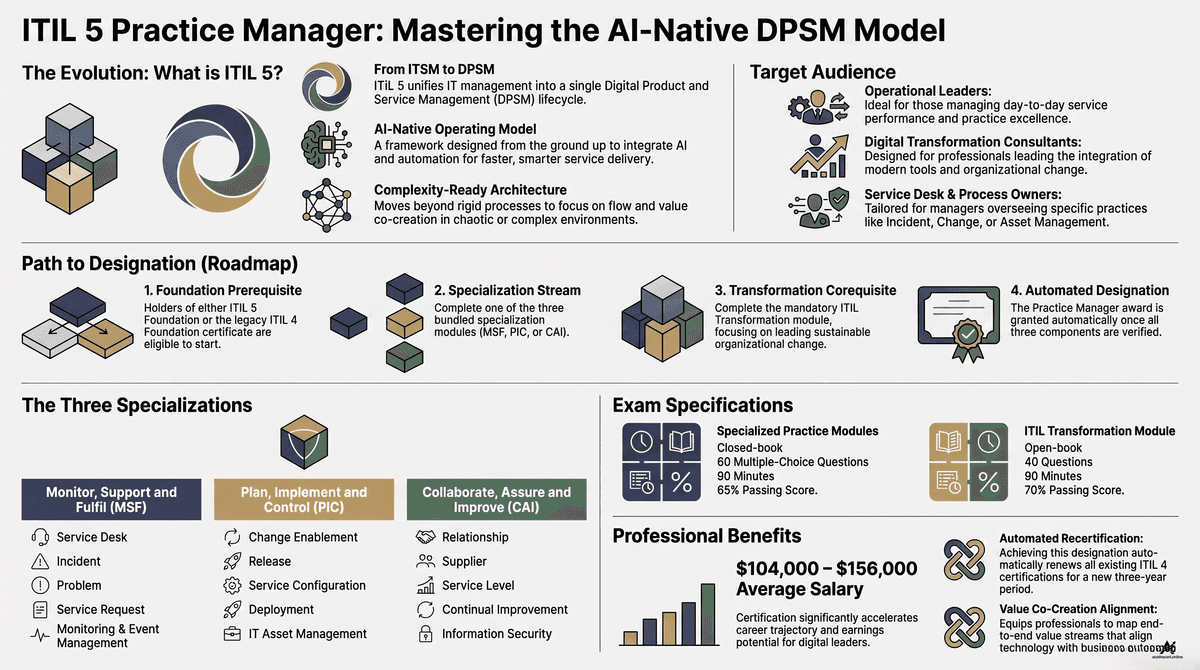
The release of ITIL® 5 in 2026 marks a definitive shift from legacy IT Service Management (ITSM) to a more robust, holistic paradigm: Digital Product and Service Management (DPSM). In an AI-native world, the framework has evolved to address the needs of organizations that must operate with unprecedented velocity and intelligence. Central to this update is the unification of the product and service lifecycle into eight interconnected activities: Discover, Design, Acquire, Build, Transition, Operate, Deliver, and Support. A hallmark of this architectural evolution is the strategic decision to split the legacy “design and transition” activity into two distinct phases. This separation is designed specifically to support modern CI/CD (Continuous Integration/Continuous Delivery) pipelines, allowing organizations to treat transition and release as highly automated workflows while maintaining a dedicated focus on human-centric, experience-driven design.
Furthermore, the nomenclature of the framework has been streamlined to reflect the full integration of digital products. The “Service Value System (SVS)” and “Service Value Chain (SVC)” have been renamed to simply the Value System and Value Chain. This removal of the word “Service” reinforces that ITIL 5 is no longer just for service providers, but for any organization managing complex digital products. To align with this unified lifecycle, traditional practice groupings (general, service, and technical) have been decommissioned. All 34 practices now reside in one of two logical categories: Product and Service Management Practices (22 practices) and General Management Practices (12 practices). Understanding this refined architecture is the prerequisite for any leader aiming for the Practice Manager designation.
2. What is the ITIL 5 Practice Manager certification?
The ITIL 5 Practice Manager (PM) designation is a strategic credential that validates a professional’s ability to orchestrate cross-practice collaboration and map end-to-end value streams within an AI-native environment. As organizations integrate algorithmic intelligence into their core operations, the PM certification focuses on the 6Cs AI Capability Model: Creation, Curation, Clarification, Cognition, Communication, and Coordination.
This certification moves beyond process-silo knowledge, validating the expert use of Value Stream Mapping (VSM) to ensure technology-enabled products consistently co-create value. It focuses on navigating organizational complexity, governing responsible AI adoption, and shifting the operational focus toward Experience-Driven Service Design (DX). For the modern professional, this designation confirms the ability to maintain accountability for automated decisions while ensuring that digital delivery remains human-centric and resilient.
3. Who is the target audience for this designation?
As digital systems become increasingly complex and interconnected, operational leadership must move beyond the “ticket management” mindset of the past. Modern excellence requires the orchestration of entire digital ecosystems. This designation is engineered for professionals who occupy the critical intersection of strategy and execution, including:
- Operational Managers: Leaders responsible for the day-to-day stability and performance of complex digital products.
- Service Desk Managers: Professionals evolving their desks from reactive recovery centers to proactive hubs that utilize AI-enabled workflows and catalog-driven fulfillment.
- Digital Transformation Consultants: Strategic advisors who must govern ongoing change and optimize service actions across diverse organizational departments.
Wielding these tools allows leadership to prove they can sustain operational throughput while simultaneously driving the velocity required by modern digital transformation.
4. What are the prior experience and prerequisites for this path?
ITIL 5 honors the professional investments of the existing practitioner community by positioning itself as an evolution rather than a total replacement. Consequently, the ITIL 4 Foundation certificate remains a valid prerequisite alongside the new ITIL 5 Foundation.
For practitioners currently holding ITIL 4 credentials who wish to fast-track their transition, the Foundation Bridge is the recommended path. This is a one-day intensive course specifically designed to update professionals on the crucial shifts in Version 5, such as the new AI Governance models, the split Design/Transition lifecycle activities, and the transition from the SVS to the unified Value System. This provides a streamlined route to the intermediate modules without requiring a retake of a full introductory exam.
5. What is the step-by-step path to achieving the Practice Manager designation?
The journey to the Practice Manager designation is modular, requiring candidates to balance deep technical practice knowledge with broad organizational transformation skills. The path consists of three distinct milestones:
- Foundation Baseline: Possession of either the ITIL 5 Foundation or the ITIL 4 Foundation certificate.
- Specialized Practice Domain: Completion of at least one three-day specialized bundle. These include:
- Monitor, Support and Fulfil (MSF): Focuses on operational stability and includes practices such as Incident, Service Desk, Problem, Service Request, and Monitoring and Event Management. Start practicing with our MSF domain quiz.
- Plan, Implement and Control (PIC): Focuses on governing the “Build-to-Deliver” pipeline and includes Change Enablement, Release, Deployment, Service Configuration, and IT Asset Management. Dive deeper with our PIC study guide.
- Collaborate, Assure and Improve (CAI): Focuses on supplier and relationship governance, including Service Level Management, Continual Improvement, and Information Security. Explore the CAI practice bundle.
- The Capstone Module: Successful completion of the mandatory ITIL Transformation module. Prepare with our ITIL Transformation domain guide.
A significant shift from the ITIL 4 era is the decommissioning of the “Create, Deliver and Support” (CDS) requirement. In Version 5, the ITIL Transformation module acts as the universal corequisite for all advanced designations, ensuring that every Practice Manager is equipped to lead digital and organizational change rather than simply managing steady-state operations.
6. What does a certified ITIL 5 Practice Manager actually do?
A certified ITIL 5 Practice Manager bridges the gap between development velocity and operational stability by acting as a value stream architect. They leverage Value Stream Mapping (VSM) to identify and eliminate bottlenecks between the “Build” and “Deliver” activities of the Value Chain. In their daily management, they apply the 6Cs model to ensure automated systems are governed effectively:
- Curation: Managing and cleaning the high-quality data sets required for AI model training and operational accuracy.
- Cognition: Applying algorithmic risk governance to ensure automated systems operate within ethical and strategic boundaries.
- Clarification: Establishing clear accountability for automated decisions, ensuring that when an AI executes a workflow, the human oversight remains robust.
Furthermore, they transition the organization from legacy uptime SLAs to Experience Level Agreements (XLAs), measuring outcomes through the lens of actual user satisfaction and business value rather than technical availability alone.
7. What is the exam format, time limit, and passing score?
The qualification scheme utilizes a dual-testing methodology to ensure both terminology comprehension and strategic application. Specialized modules use a closed-book format, while the Transformation capstone allows for open-book reference of the official eBook and scenario materials.
| Feature | Specialized Modules (MSF/PIC/CAI) | ITIL Transformation Module |
|---|---|---|
| Question Count | 60 Questions | 40 Questions |
| Passing Score | 65% (39 correct) | 70% (28 correct) |
| Time Limit | 90 Minutes | 90 Minutes |
| Format | Closed-book | Open-book |
| Platform | PeopleCert Online Proctored | PeopleCert Online Proctored |
Explore All ITIL 5 Practice Manager Domains
- Domain 1: Monitor, Support and Fulfil (MSF) — Master Service Desk, Incident, Problem, Service Request, and Monitoring practices.
- Domain 2: Plan, Implement and Control (PIC) — Govern the “Build-to-Deliver” pipeline with Change Enablement, Release, and Deployment Management.
- Domain 3: Collaborate, Assure and Improve (CAI) — Manage supplier relationships, SLAs, continual improvement, and information security.
- Domain 4: ITIL Transformation — Lead digital and organizational change as the universal capstone module.
Frequently Asked Questions
What is the ITIL 5 Practice Manager certification?
What are the prerequisites for ITIL 5 PM?
What is the MSF practice bundle?
How many questions on the Practice Manager exam?
What does a certified ITIL 5 Practice Manager do?
Ace The Cert Team
The official editorial team for Ace The Cert.
Related Posts
The Ultimate Guide to ITIL 5 Foundation: Master the Future of Digital Product Management
Master the ITIL 5 Foundation certification with our comprehensive guide. Learn the PSLM, 6C AI Model, exam format, costs, and career pathways for 2026.
Mastering the Shift: ITIL 5 Managing Professional Certification Guide
Complete guide to the ITIL 5 Managing Professional certification. Learn about ITIL Product, Service, Experience & Transformation modules, exam format, eligibility, and career impact.
Elevating the Enterprise: The Executive Guide to ITIL 5 Master Certification
The definitive guide to the ITIL 5 Master certification. Learn the modular blueprint (PM, MP, SL), eligibility, exam formats, investment costs, and C-suite career impact.
Comments are not configured for this site.