Elevating the Enterprise: The Executive Guide to ITIL 5 Master Certification
1. Introduction: The Shift to Digital Product and Service Management (DPSM)
In the current era of rapid technological disruption, the role of IT has fundamentally shifted from a back-office support function to a primary engine of value creation. ITIL (Version 5) marks this critical evolution, moving beyond traditional service management into the comprehensive realm of Digital Product and Service Management (DPSM). This framework unifies the entire lifecycle—from design to continual improvement—into a single, cohesive approach designed for a product-centric economy.
The ITIL 5 Master certification stands as the absolute pinnacle of this qualification scheme. It is an elite designation reserved for leaders who have developed an exhaustive knowledge base and proved their ability to apply ITIL principles at strategic, tactical, and operational levels. In an AI-enabled landscape, achieving “Master” status is the ultimate signal of leadership, demonstrating that you possess the mastery required to orchestrate digital value across the modern enterprise.
2. The Strategic “Why”: Value, Recognition, and Salary Potential
For Fortune 500 leadership, the adoption of ITIL 5 is a decision rooted in competitive positioning and capability development. This framework ensures that technology investments are not merely operational expenses but are directly aligned with business outcomes and long-term value realization. Having Master-level certified leaders provides an organization with a sophisticated internal consultancy capable of navigating complex digital transformations with global best practices.
The return on investment for this certification is quantified through high international recognition and demand from global employers. Executives can leverage industry-standard resources like the Salary Explorer and Career Guides from Learners Ink to validate the significant ROI and salary potential associated with these advanced designations. This certification is tailor-made for high-impact roles, including:
- C-Suite Leaders: CIOs, CTOs, and CDOs driving the digital agenda.
- Strategy & Portfolio Managers: Overseeing investment and alignment.
- Digital Product & Transformation Managers: Leading the shift to DPSM.
- Enterprise Architects: Designing the future-state operating model.
3. Core Competencies: Strategic Frameworks and Cross-Framework Literacy
The ITIL 5 Master designation represents a level of expertise that transcends a single manual. It requires a profound “cross-framework literacy,” where leaders honor the past but are not bound to it. Master-level candidates are assessed on their ability to integrate ITIL 5 with modern ways of working, including Lean, SRE, and DevOps. Start with our foundational domains: Value Streams & Service Design and DevOps, SRE & Platform Engineering.
Key executive-level competencies assessed include:
- Strategic Direction Setting: Utilizing sophisticated tools such as Wardley Mapping for competitive landscape analysis and Hoshin Kanri for strategic policy deployment. Practice in our Strategic Direction & Portfolio domain.
- Governance and Assurance: Implementing the Three Lines of Defence model to ensure robust board-level reporting and risk management. Explore Continual Improvement & Governance.
- Value Co-creation & Experience: Moving beyond traditional SLAs to XLAs (Experience Level Agreements), prioritizing both customer and employee experience. Master this in our Service Relationship & Value domain.
- AI Augmented Strategy: Navigating the ethical, compliant, and responsible adoption of artificial intelligence within the digital strategy. Deep-dive with AI-Augmented Strategy & Sustainability.
4. Eligibility and Prerequisites: No Redundancy, Just Forward Momentum
The path to Master status is built upon a solid foundational understanding of the DPSM lifecycle. Entry into the qualification scheme requires ITIL 4 Foundation or ITIL 5 Foundation.
A critical strategic advantage of the current rollout is the 12-month coexistence period between ITIL 4 and ITIL 5. Leaders should note that even expired ITIL Foundation certificates remain valid prerequisites for entering advanced ITIL 5 courses. This approach embodies the philosophy of: “No redundancy. No rework. Just forward momentum.” This ensures that your previous investments in the framework are respected as you transition into advanced leadership designations.
5. The Modular Blueprint: A Step-by-Step Path to Master
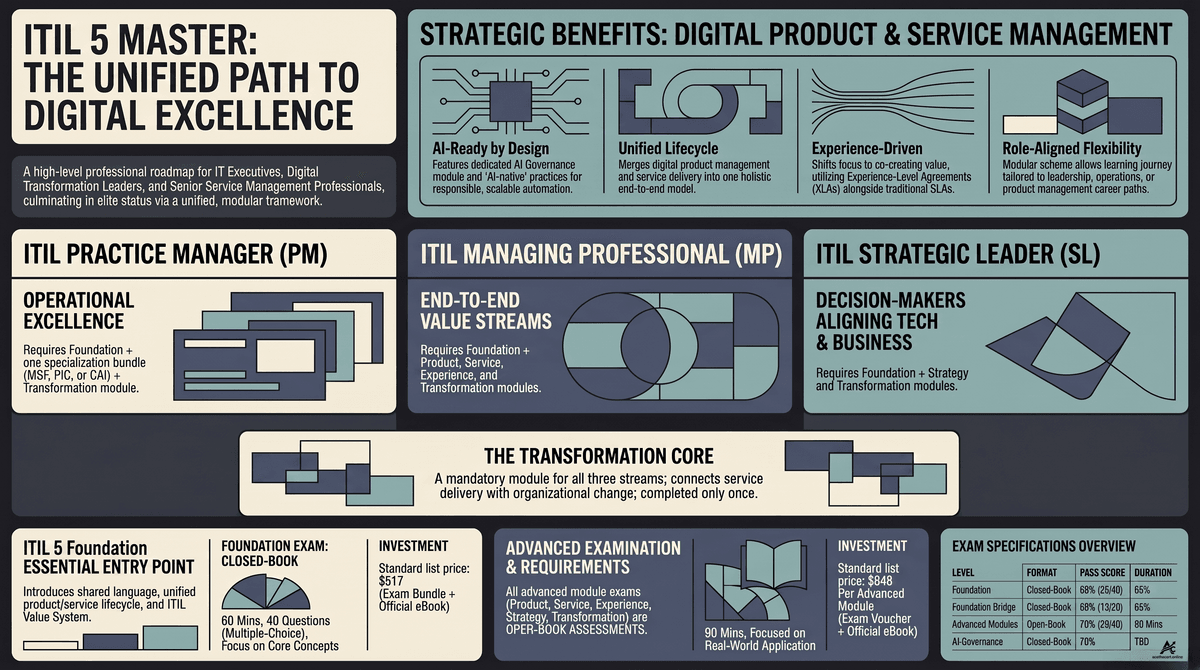
The ITIL 5 Master designation is awarded once a candidate has successfully achieved three distinct advanced designations. This modular structure allows for role-based exploration while building toward a comprehensive view of the enterprise:
- ITIL 5 Practice Manager (PM): Validates practical, real-world capability across service management practices. Begin with Service Operation & Workforce and Stakeholder Engagement.
- ITIL 5 Managing Professional (MP): Focuses on technology and digital team leadership. This requires the completion of three specific modules: ITIL Product, ITIL Service, and ITIL Experience. Prepare with High-Velocity Culture & Toil.
- ITIL 5 Strategic Leader (SL): Focuses on aligning DPSM with enterprise strategy and governance. Study the strategic domains: Strategic Direction Setting, Strategic Risk & Resilience, and Continual Strategic Improvement.
The connective tissue of this blueprint is the ITIL 5 Transformation Module. This module is required for all three designations but only needs to be completed once. For those already holding an ITIL 4 Managing Professional or v3 Expert status, the Managing Professional Transition (MPT) module serves as an accelerated bridge to the ITIL 5 MP designation.
Also explore: Digital Strategy & Business and Digital Operating Model.
6. Tactical Execution: Benchmarks of Organizational Rigor
The examination process is designed to be a rigorous assessment of professional standards, ensuring that a Master-level candidate can apply knowledge under pressure.
| Feature | Executive Specification |
|---|---|
| Exam Format | Advanced Strategic modules are Open-Book, reflecting real-world leadership scenarios. |
| Minimum Passing Score | 70% (typically 28 out of 40 questions per module). |
| Examination Duration | 90 minutes for Strategy; up to 360 minutes for comprehensive MP mock exams. |
| Mock Exam Context | The 360-minute mock exam covers 160 questions across all four MP domains (CDS, DSV, HVIT, DPI). |
Candidates prepare using Official Prep Resources such as the ITSM Academy Learner Portal, digital manuals, and the “Game On!” interactive learning simulations. These tools are designed to move beyond rote memorization and toward the mastery of key vocabulary and strategic application.
7. The Investment: Costs and Time Commitment
Developing organizational capability at the Master level requires a commitment of both capital and time. These costs should be viewed as a strategic investment in the firm’s human capital:
- Financial Investment: An ITIL 5 Strategy course is typically priced at $2,610, which includes the accredited training, official exam voucher, and the official digital eBook.
- Time Commitment:
- Foundation: 2.5-day physical classroom or virtual equivalent.
- Strategy: 4-day intensive immersion.
- MP Transition: 5-day bridge for existing experts.
8. Sustainability of Excellence: Expiration and Renewal
In a market driven by AI and rapid innovation, “Mastery” is a moving target. To ensure ITIL 5 remains a signal of current excellence, certifications are subject to a 3-year renewal cycle.
Validity is maintained through the PeopleCert Continuing Professional Development (CPD) program. By logging “Professional Education Hours” (PDUs/CPEs) and maintaining a PeopleCert+ membership, leaders demonstrate their commitment to ongoing growth and the “Just Keep Learning” philosophy. This ensures that the Master designation remains a relevant, living credential.
9. The Professional Brand: LinkedIn and Resume Optimization
Achieving the Master designation is a significant milestone in a professional journey. Signalling this expertise to the global professional community is essential for career advancement and organizational prestige:
- Digital Badging: Immediately add your digital badge to your LinkedIn profile and update the “Certifications” section with your specific designations (PM, MP, SL).
- Leverage PeopleCert+: Use your membership to access the ITIL Official Practice Guides, which provide the practical toolkits and templates needed to apply your learning to current business challenges.
- Personal Action Plan: Utilize the Personal Action Plan provided during training to translate classroom theory into a roadmap for organizational improvement within your first 90 days post-certification.
10. Conclusion: Your Legacy in the Digital Era
The journey to becoming an ITIL 5 Master is about more than a title; it is about the transformation of the IT leader into a strategic architect of the digital era. It requires a commitment to the “Just Keep Learning” philosophy and a willingness to lead organizations through the complexities of AI-enabled disruption.
By mastering the ITIL 5 framework, you are not just managing services; you are building a legacy of excellence, ensuring that your organization remains adaptive, responsible, and sustainable. The era of Digital Product and Service Management is here—lead it with the authority of an ITIL 5 Master.
Explore All ITIL 5 Master Domains
- Domain 1: Value Streams & Service Design — Architect value streams and design services for maximum value co-creation.
- Domain 2: Service Operation & Workforce — Lead operational teams and workforce strategies in high-velocity environments.
- Domain 3: Stakeholder Engagement & Customer — Master stakeholder management and customer-centric service delivery.
- Domain 4: Service Relationship & Value — Transition from SLAs to XLAs and optimize service relationships.
- Domain 5: DevOps, SRE & Platform Engineering — Integrate modern engineering practices with ITIL governance.
- Domain 6: High-Velocity Culture & Toil — Build resilient cultures and eliminate operational toil.
- Domain 7: Strategic Direction & Portfolio — Align digital portfolios with enterprise strategy using Wardley Mapping.
- Domain 8: Continual Improvement & Governance — Implement Three Lines of Defence and governance frameworks.
- Domain 9: Strategic Direction Setting — Define and cascade strategic direction across the organization.
- Domain 10: Strategic Risk & Resilience — Manage enterprise risk appetite and build operational resilience.
- Domain 11: Continual Strategic Improvement — Drive ongoing improvement at the strategic portfolio level.
- Domain 12: Digital Strategy & Business — Align digital and business strategies for competitive advantage.
- Domain 13: Digital Operating Model — Design adaptive operating models for the digital era.
- Domain 14: AI-Augmented Strategy & Sustainability — Govern responsible AI adoption and integrate sustainability into strategy.
Frequently Asked Questions
What is the ITIL 5 Master certification?
What are the prerequisites for ITIL 5 Master?
How long does it take to achieve ITIL 5 Master?
How much does the ITIL 5 Master path cost?
Is ITIL 5 Master worth it for C-suite executives?
Ace The Cert Team
The official editorial team for Ace The Cert.
Related Posts
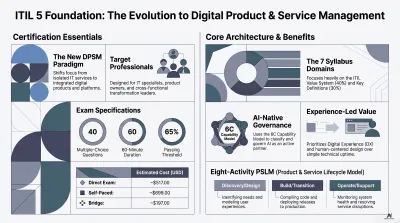
The Ultimate Guide to ITIL 5 Foundation: Master the Future of Digital Product Management
Master the ITIL 5 Foundation certification with our comprehensive guide. Learn the PSLM, 6C AI Model, exam format, costs, and career pathways for 2026.
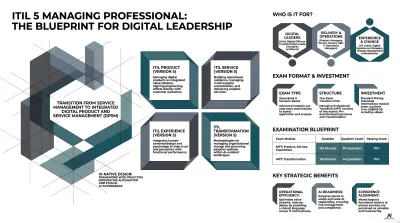
Mastering the Shift: ITIL 5 Managing Professional Certification Guide
Complete guide to the ITIL 5 Managing Professional certification. Learn about ITIL Product, Service, Experience & Transformation modules, exam format, eligibility, and career impact.
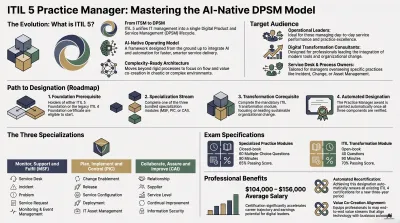
Elevating Operational Excellence: The ITIL 5 Practice Manager Certification Overview
Master the ITIL 5 Practice Manager designation with our complete guide. Explore MSF, PIC, and CAI practice bundles, exam format, prerequisites, and career pathways for operational leaders.
Comments are not configured for this site.