Mastering Digital Strategy: The Definitive Guide to ITIL 5 Strategic Leader Certification
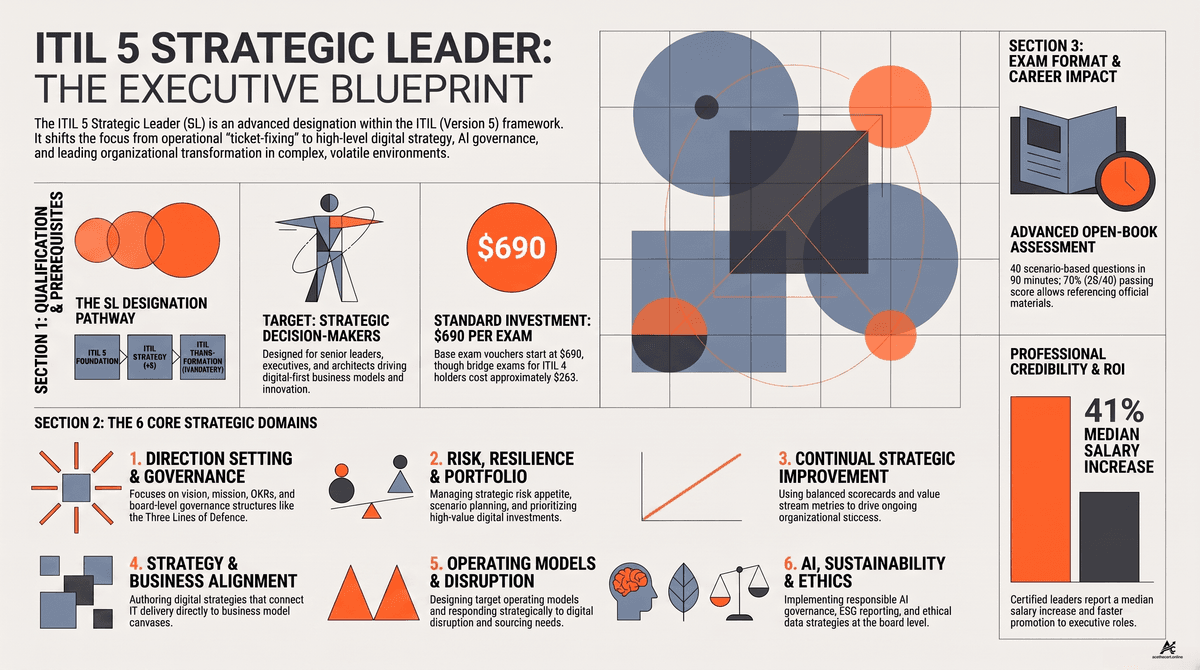
The Evolution of IT Service Management
The landscape of technology management has reached a critical inflection point. With the global rollout of ITIL 5 in early 2026, we are witnessing a fundamental shift from traditional IT operations toward Digital Product and Service Management (DPSM). In today’s AI-enabled, product-centric economy, organizations no longer view digital transformation as a temporary response to crisis but as a permanent strategic differentiator. To compete, enterprises must unify their service lifecycles and ensure that every technology investment is directly tied to measurable business outcomes.
Central to this evolution is the “Direct, Plan, and Improve” ethos, which mandates that IT is no longer a siloed support function but a core component of enterprise strategy. Achieving this alignment requires a new breed of professional capable of navigating complexity with both tactical precision and visionary oversight. This is precisely where the Strategic Leader designation becomes the essential credential for the modern executive.
What is the ITIL 5 Strategic Leader (SL) Certification?
The ITIL 5 Strategic Leader (SL) designation is a high-level tier within the updated qualification scheme, designed to validate an individual’s ability to navigate the intersection of digital technology and business strategy. Unlike traditional technical certifications, the SL pathway is a role-based qualification that focuses heavily on governance, investment prioritization, and the successful execution of digital transformation. Begin your journey with our Strategic Direction domain guide.
The key differentiator of the Strategic Leader stream—when compared to the Managing Professional (MP) track—is its emphasis on “leadership-oriented learning.” While the MP stream focuses on the operational mastery of product delivery and experience management, the Strategic Leader path is dedicated to business-IT alignment. It empowers professionals to author digital strategies that are not only effective but also adaptive and sustainable in a rapidly changing market. It serves as the bridge between day-to-day IT service delivery and the long-term vision of the C-suite.
Target Audience: Who Should Pursue This Credential?
As the gap between technology and business outcomes continues to close, specific leadership roles are now required to act as the primary translators between these two worlds. Organizations are actively seeking leaders who can move beyond “keeping the lights on” to driving measurable business value through digital disruption.
Based on global industry needs, the ideal candidates for this credential include:
- C-Suite Executives (CIOs, CTOs, CDOs): Those defining the organization’s digital vision.
- IT Directors and Strategy Managers: Leaders responsible for aligning departmental goals with enterprise-level outcomes.
- Digital Transformation Leaders: Professionals tasked with managing organizational change and operating model evolution.
- Portfolio and Product Managers: Individuals overseeing investment decisions and product lifecycles.
- Enterprise Architects and Business Consultants: Strategists designing the future state of the digital enterprise.
For a mid-level manager, this certification represents a “So What?” breakthrough. It transforms a professional from a functional manager into a strategic partner capable of responding to digital disruption with clarity and confidence, ensuring that technology serves as a catalyst for growth rather than a cost center.
Skills Assessed and Core Competencies
In a VUCA (Volatile, Uncertain, Complex, and Ambiguous) environment, technical skill alone is insufficient. The ITIL 5 Strategic Leader path assesses a specific set of high-level competencies required to guide an organization through uncertainty using proven methodologies such as Wardley Mapping for competitive positioning and Hoshin Kanri for strategy cascading.
The core skills assessed include:
- Digital Strategy Authoring: Utilizing the Business Model Canvas to align IT strategy with enterprise-wide goals and digital vision setting. Practice this in our Digital Strategy & Business domain.
- Responsible AI Governance: Developing ethical and compliant AI strategies, focusing on board-level governance, risk management, and transparency. Deepen your understanding with AI-Augmented Strategy.
- Strategic Risk & Resilience: Defining risk appetite and building operational resilience through scenario planning and the “Three Lines of Defence” governance model. Master this with our Strategic Risk & Resilience guide.
- Organizational Change Management (OCM): Utilizing complexity thinking to manage high-stakes transitions and cultural shifts at the portfolio level.
- Sustainability and Digital Ethics: Integrating ESG reporting and carbon-aware strategies into the digital product lifecycle.
Importantly, while these skills are highly sophisticated, no coding is required. The focus remains entirely on strategic oversight, governance, and no-code AI programming concepts, making it accessible to business-oriented leaders. Before mastering these competencies, one must understand the specific modular architecture required to earn the designation.
The Step-by-Step Path to Certification
The ITIL 5 qualification scheme is modular by design, allowing professionals to tailor their development to their specific career trajectory. To achieve the Strategic Leader designation, candidates must navigate a structured process:
- Foundation: Achieve the ITIL 5 Foundation certification. While ITIL 4 Foundation remains a valid prerequisite during the 2026 transition, ITIL 5 Foundation is the primary entry point for the new scheme.
- Digital and IT Strategy (DITS): Complete this dedicated module covering the full lifecycles of strategy development and implementation.
- Direct, Plan and Improve (DPI) or Transition: Complete the DPI module, which is a core requirement for multiple designations. Alternatively, professionals who already hold the ITIL 4 Managing Professional designation can take the Managing Professional Transition (MPT) bridge to satisfy the Transformation requirements.
Beyond this designation, the SL path serves as a mandatory component for those striving to achieve the ITIL 5 Master level—the highest recognition in the scheme. Note that becoming a Master requires achieving three distinct designations: Practice Manager, Managing Professional, and Strategic Leader. Once the educational path is clear, the next hurdle is the rigorous assessment designed to validate your strategic acumen.
Exam Format and Preparation Strategy
To maintain its global standing and professional credibility, the ITIL 5 Strategic Leader assessment is rigorous. The Digital and IT Strategy (DITS) module utilizes an open-book format to mirror real-world leadership scenarios where synthesis of information is more valued than rote memorization.
| Feature | Official DITS Exam Details | Full SL Practice Test (Learners Ink) |
|---|---|---|
| Format | Open-book | Mock Exam PDF |
| Duration | 90 Minutes | 180 Minutes |
| Question Count | 40 Questions | 80 Questions |
| Passing Score | 70% | 70% |
| Languages | English | English |
To prepare effectively, candidates should leverage official PeopleCert Plus memberships for access to practice guides and toolkits. Accredited training cohorts often utilize “Game On!” interactive learning tools to simulate complex decision-making. For hands-on practice, test yourself with our Continual Strategic Improvement quiz.
Investment: Cost, Time, and Prep Requirements
Earning the Strategic Leader designation should be viewed as a capital investment in one’s professional human resources. As an executive coach, I recommend using the “Personal Action Plan” template provided in these courses to map your certification journey directly to your career milestones.
- Financial Investment: The MSRP for individual leadership modules is approximately $2,710, though promotional pricing can often be found around $2,610. This typically includes the exam voucher and digital eBook.
- Time Commitment: Instructor-led courses require 24 professional education hours.
- Resource Availability: Several providers offer free full-length practice tests to help map out the journey without immediate cost.
With the investment of time and capital understood, we can now examine the substantial professional returns this credential unlocks.
Career Impact: Salary Potential and Global Recognition
The global demand for leaders who can manage digital products and services is at an all-time high. Because ITIL is recognized internationally by PeopleCert and Axelos, this credential provides a portable, high-value standard that global enterprises prioritize.
Salary Insights for Strategic Leader Roles (Source: Glassdoor):
- IT Director: ₹40 LPA
- Enterprise Architect: ₹30 LPA
- Digital Transformation Manager: ₹22.8 LPA
- Program Manager (IT Services): ₹22 LPA
These figures reflect the significant premium placed on professionals who can bridge the gap between technical execution and board-level strategy. Sustaining these career gains requires a commitment to lifelong learning and regular certification maintenance.
Maintenance: Expiration and Renewal Requirements
In a rapidly evolving economy driven by AI and shifting business models, continuous professional development is essential. ITIL certifications are not “one and done” achievements; they require active maintenance to remain valid in a competitive market.
The certification operates on a 3-year renewal cycle. Professionals maintain their status through the PeopleCert Continuing Professional Development (CPD) program, which involves logging points for ongoing learning and practical application. Once achieved, the designation should be highlighted on LinkedIn and resumes to signal your commitment to staying at the forefront of digital service leadership.
Conclusion: Is the ITIL 5 Strategic Leader Certification Worth It?
The ITIL 5 Strategic Leader certification is more than a credential; it is a framework for acting with clarity and confidence in complex environments. By synthesizing governance, risk management, and digital strategy, it provides the tools necessary to ensure technology investments consistently deliver measurable business value.
Expert Recommendation: For professionals aiming for the C-suite or senior director roles, the investment is undeniably worthwhile. The true value of the Strategic Leader designation is unlocked when the certification is combined with the “Personal Action Plan” to solve real-world organizational challenges. By applying these strategic principles to digital disruption, you position yourself as an indispensable asset for the 2026 economy and beyond.
Explore All ITIL 5 Strategic Leader Domains
- Domain 1: Strategic Direction — Define organizational vision and align digital investments with enterprise goals.
- Domain 2: Strategic Risk & Resilience — Build operational resilience through the Three Lines of Defence and scenario planning.
- Domain 3: Continual Strategic Improvement — Drive ongoing strategy refinement using feedback loops and maturity models.
- Domain 4: Digital Strategy & Business — Author digital strategies using the Business Model Canvas and Wardley Mapping.
- Domain 5: Digital Operating Model — Design adaptive operating models for the digital enterprise.
- Domain 6: AI-Augmented Strategy — Govern ethical, transparent, and responsible AI adoption at the board level.
Frequently Asked Questions
What is the ITIL 5 Strategic Leader certification?
Who should pursue ITIL 5 Strategic Leader?
What is the exam format for ITIL 5 SL?
How much does ITIL 5 Strategic Leader cost?
What skills does ITIL 5 SL assess?
Ace The Cert Team
The official editorial team for Ace The Cert.
Related Posts
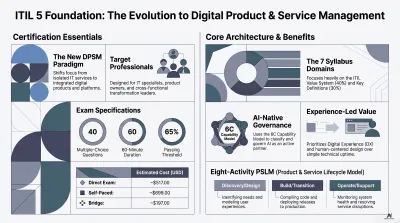
The Ultimate Guide to ITIL 5 Foundation: Master the Future of Digital Product Management
Master the ITIL 5 Foundation certification with our comprehensive guide. Learn the PSLM, 6C AI Model, exam format, costs, and career pathways for 2026.
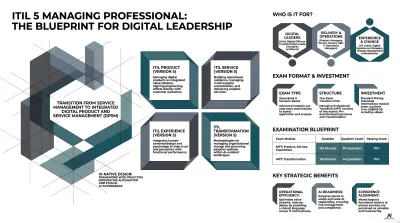
Mastering the Shift: ITIL 5 Managing Professional Certification Guide
Complete guide to the ITIL 5 Managing Professional certification. Learn about ITIL Product, Service, Experience & Transformation modules, exam format, eligibility, and career impact.
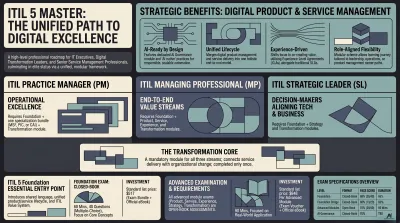
Elevating the Enterprise: The Executive Guide to ITIL 5 Master Certification
The definitive guide to the ITIL 5 Master certification. Learn the modular blueprint (PM, MP, SL), eligibility, exam formats, investment costs, and C-suite career impact.
Comments are not configured for this site.